Most HR disasters don’t actually begin in HR. They begin in Finance, Operations, Procurement, or deep within a manager’s office.
Consider the everyday scenarios that quietly unfold across an organization: a salary increase is promised without considering the company’s broader pay philosophy ; a restructuring is approved without understanding the legal implications ; a contractor is engaged in a way that creates unexpected employment liability ; or a shift pattern is changed without considering labour laws or employee wellbeing.
None of these decisions are made by HR. Yet, the HR department is universally expected to deal with the consequences.
This points to one of the biggest misconceptions in business today: the belief that HR problems originate within HR. In reality, the most expensive people issues begin as standard business decisions made elsewhere in the organization—and by the time HR is pulled into the room, the damage is often already done.
Every Business Decision Has a People Consequence
People decisions are not confined to a single department; they happen every day across every function:
- Finance decides whether a new role fits the budget.
- Operations redesigns reporting lines to optimize workflow.
- Sales managers promise quick promotions to retain key performers.
- Procurement engages external consultants and contractors.
- Department heads approve overtime, manage day-to-day performance, and recommend disciplinary action.
- Executive leadership approves macro-level restructures, acquisitions, and workforce reductions.
Each of these decisions makes perfect commercial sense from the perspective of the department making it. However, they all carry legal, financial, operational, and cultural implications that extend far beyond that single department.
The core challenge isn’t that these decisions are inherently wrong. The challenge is that they are made in isolation.
The Real Problem: Organizational Silos
Most organizations don’t intentionally create people problems—they create silos. Departments become highly effective at achieving their own distinct objectives but disconnected from the wider impact of their decisions.
| Department | Primary Focus |
| Finance | Cost management |
| Operations | Productivity |
| Procurement | Commercial value |
| Department Heads | Immediate results |
| HR | People |
While each function is performing exactly as expected, no one is connecting the dots. When departments operate independently, organizations experience systemic issues that seem unrelated until someone steps back to look at the whole picture. Managers address misconduct differently across departments, recruitment proceeds without succession planning, compensation decisions create internal equity issues, and compliance gaps emerge because operational changes were never reviewed through an HR lens.
These issues accumulate quietly until they become incredibly expensive.
The Cost of Disconnected Decisions
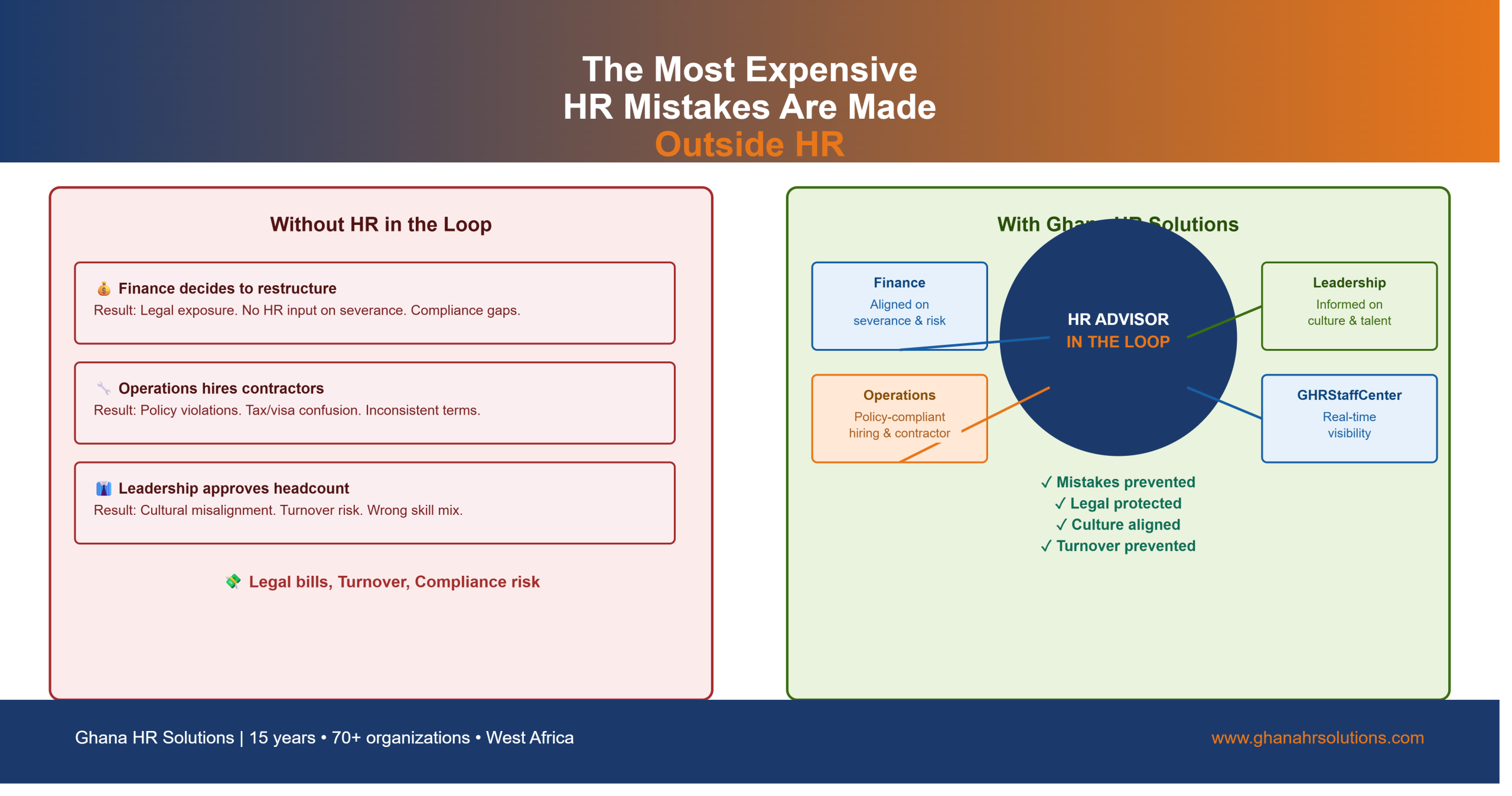
Imagine a common scenario: A manager notices an employee’s performance declining. Operations believes the role should be replaced, Finance approves the budget for a replacement, and the recruitment process begins.
Throughout this entire process, HR has not been involved. Nobody has explored whether the performance issue stems from workload, burnout, inadequate supervision, unclear expectations, or personal circumstances.
Several months later, the Organisation faces an employee grievance, expensive legal advice is sought, customers are disrupted during the messy transition, recruitment costs skyrocket, and valuable organizational knowledge walks out the door.
Everyone focuses on the termination, but the real breakdown happened months earlier when business decisions were made without understanding their people implications. This is “The Advisor Gap”—the disconnect between making a business decision and understanding its true impact on people.
HR Thinking Before HR Processing
Too often, HR is treated as a processing function brought in after the fact. The vacancy has already been approved, the promotion promised, the restructuring announced, or the disciplinary process started. At that point, HR is no longer helping shape the decision; it is simply managing its fallout.
Organizations that consistently build strong cultures and minimize people risk approach things differently: they bring HR into the conversation before decisions are finalized. Not because HR should make every business decision, but because every business decision involving people deserves an HR perspective.
An effective HR advisor helps leadership ask better, proactive questions:
- What employment risks are we creating?
- How will this decision affect overall morale?
- Are we being consistent with internal policy and our compensation philosophy?
- Have we considered succession and potential alternatives?
- Could this decision create legal exposure six months from now?
These questions rarely slow organizations down; more often than not, they prevent incredibly costly mistakes.
Closing the Gap
At Ghana HR Solutions, we believe HR should never operate as an isolated support function—and neither should Finance, Operations, or Procurement. Our role is to help organizations connect people decisions across every single function.
Through strategic HR consulting, operational HR support, Employer of Record (EOR) services, and our GHRStaffCenter HRIS platform, we provide leadership with a complete, unified view of their workforce. We deliver more than just payroll data, recruitment updates, or compliance reports; we provide meaningful insight that enables better business decisions before problems emerge.
Because the best HR advisors don’t simply solve people problems—they help organizations avoid creating them in the first place.
The Bottom Line
Every promotion, salary adjustment, restructuring, recruitment decision, performance conversation, and termination is a business decision. But they are also people decisions. The organizations that consistently outperform others understand one simple principle: Every people decision deserves HR thinking before it deserves HR paperwork